
Summary
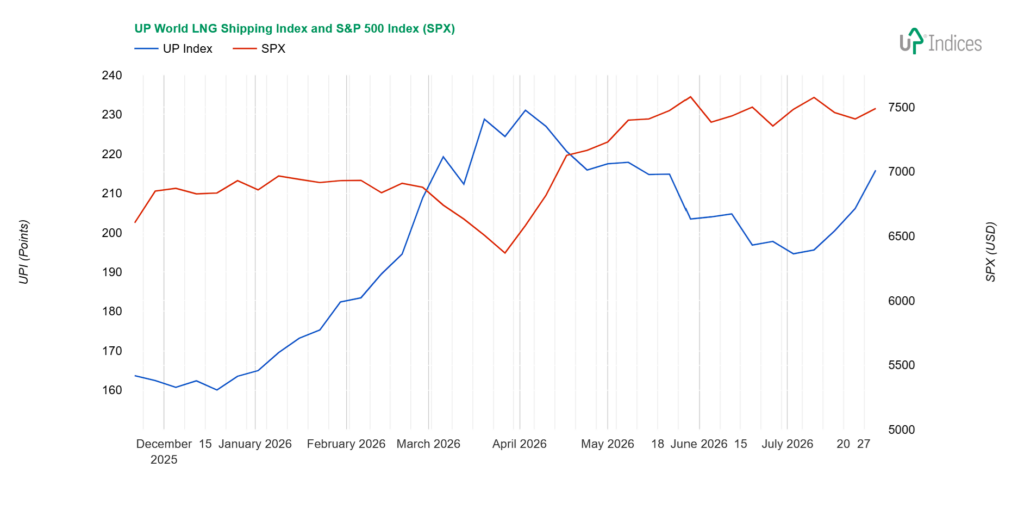
The UP World LNG Shipping Index gained 9.73 points (4.72%) last week, closing at 215.82 points, while the S&P 500 gained 1.1%. At the regular rebalancing, South Korean firm PAN Ocean (KRX: 028670) was added, bringing the total to 21 constituents. The UPI continues to rise, with a 15:6 ratio of advancing to declining stocks, though the weighted index rose to a lesser extent. Asian spot LNG prices weakened slightly by $0.65/mmBtu but remain very high, as Qatari exports remain severely restricted. Spot tanker rates fell sharply to $78,250/day for the Atlantic while the Pacific held at $75,500/day. COSCO Shipping Energy Transportation led the gainers for a second consecutive week with +8.49%, while New Fortress Energy fell the most at -8.47%.
UPI & SPX
The UP World LNG Shipping Index, which tracks 21 listed LNG shipping companies, gained 9.73 points (4.72%), closing at 215.82 points, while the S&P 500 index gained 1.1%. The chart below illustrates the performance of both indices with weekly data.
Broader View
During the regular rebalancing, the number of companies was expanded to include the South Korean firm PAN Ocean (KRX: 028670), bringing the total to 21.
The UPI continues to rise. The ratio of rising to falling companies was 15:6, whilst trading volume was lower than the week before last. The weighted index (wUPI) also rose, albeit to a lesser extent, as did the median price change.
Asian spot LNG prices weakened slightly but remain at very high levels. According to Friday’s Reuters summary, the decline amounted to $0.65 per mmBtu. The reasons are, of course, geopolitical, as Qatari exports are severely restricted, if not halted.
“Whilst reduced Egyptian regasification capacity (following the drone attacks) could temporarily free up cargoes for Europe, Egypt could return aggressively to the market should import constraints ease, sustaining competition for Atlantic Basin supply,” said Aly Blakeway, head of Atlantic LNG at S&P Global Energy.
Spot rates for LNG tankers fell sharply to $78,250 per day for the Atlantic, whilst for the Pacific they remain at $75,500 per day, according to Spark Commodities.
Constituents
The Chinese company COSCO Shipping Energy Transportation (SS: 600026) recorded the largest increase for the second time in a row. It rose by 8.49 per cent, though this may still merely be a correction following a decline.
ALNG (OSE: ALNG) recorded the second-largest rise, up 5.72 per cent. This rise was sufficient to break through the resistance level of the sideways trend. However, trading volume remains low.
Shell (NYSE: SHEL) rose by 4.1 per cent, bringing it back below its spring highs. The rise was accompanied by increased trading volume.
Newcomer PAN Ocean gained 3.6 per cent; despite an attempt to rise, the price remained at the key resistance level of the sideways trend.
bp (NYSE: BP) is behaving similarly to Shell, though its rise was weaker at 3.2 per cent. Here too, however, the rise was accompanied by increased trading volume.
The chart for NYK Line (TSE: 9101) looks much the same, with the stock rising by 2.8 per cent.
No fewer than six companies gained by at least one per cent: Tsakos Energy Navigation (NYSE: TEN; +1.83 per cent), Excelerate Energy (NYSE: EE; +1.66 per cent), “K” Line (TSE: 9107; +1.57 per cent), Flex LNG (NYSE: FLNG; +1.17 per cent), Golar LNG (NASDAQ:
GLNG; +1.09 per cent) and Chevron (NYSE: CVX; +1.05 per cent).
Tsakos continues to trade sideways, but is pushing towards the upper edge of this range. Excelerate Energy posted a single positive candle following three weeks of negative candles, with no negative price action. The situation therefore remains indecisive.
“K” Line “broke away” and jumped above previous levels via a gap. The gap was closed during the week, raising hopes for continued growth.
For the fourth week running, Flex LNG attempted to rise above previous levels, and this time it almost succeeded. However, resistance has not yet been fully overcome.
Conversely, after a series of downward pressures on the lower end of the sideways range and its breakout the week before last, Golar successfully returned to that range last week. And on above-average volume.
Chevron has been demonstrating the strength of its magnetic resistance for the second week running. Although it broke through the resistance the week before last, it did not rise sufficiently, and the price failed to surpass its previous high. It did not succeed on the second attempt either, even though the price rose again.
Mitsui O.S.K. Lines (TSE: 9104) rose by 0.87 per cent, and here too, the magnetic resistance is playing a role. The question is whether there will be another attempt at an uptrend or, conversely, a downtrend.
Nakilat (QSE: QGTS) is trading at the lower end of its sideways range due to geopolitical pressure. This time it rose by 0.7 per cent, but of course that does not resolve anything.
Dynagas LNG Partners (NYSE: DLNG) is trading sideways. The closing gain of 0.6% masks attempts at both an uptrend and a downtrend; the situation is ambiguous.
If we disregard the 8.47% fall in New Fortress Energy (NASDAQ: NFE) – which, given the volatility, is actually a relatively mild movement – the second-largest decline was seen in Capital Clean Energy Carriers (NASDAQ: CCEC). It fell by 4.6%, reversing its previous gains. It is interesting to note that, even here, the stock failed to break through the ‘magnetic’ resistance level after initially breaching the resistance.
Exmar (EBR: EXM) fell by 2.61 per cent, though this is not a significant move given the low trading volume.
The last three companies fell by 0.3 per cent: MISC (KLSE: 3816), Korea Line Corporation (KRX: 005880) and ADNOC Logistics & Services (ADX: ADNOCLS).
Crystal Ball
Qatar has been temporarily sidelined among the conflict’s losers due to industrial damage to its facilities, whilst US LNG exporters emerge as the clear winners. European importers were shielded from spot price increases thanks to predominantly long-term U.S. contracts. However, these contracts are not sufficient to replenish inventories for the winter, and European companies must return to the market despite Qatar’s continuing export restrictions. We expect most of the rising US gas production will flow towards Europe. New global LNG producers should also benefit from this conflict, as energy source diversification becomes more important than ever—provided importing economies remain healthy enough to absorb higher energy costs.
The outlook remains volatile, but positive in the long term. Companies with spot tankers are benefiting from high rates and longer distances. The gradual phasing out of steamers and the addition of new liquefaction capacity will continue to drive the sector forward.
About UPI
Established in 2020, the UP World LNG Shipping Index is a rules-based family of stock indices designed to measure the performance of publicly traded companies worldwide engaged in the maritime transportation of liquefied natural gas (LNG). This unique index comprises 21 companies and partnerships worldwide, representing more than 65% of the global LNG carrier fleet in 2020. The UP Index provides premium services, offering freemium and trial access to charts. With the Freemium plan, users can access the basic UP Index vs S&P 500 chart after completing email registration. The trial includes full access for fourteen days.
Final Note
This report primarily relies on technical analysis using weekly data. The summary section is AI-generated.
Disclosure: The author holds beneficial long positions in the shares of ALNG, EE, FLNG, and NFE, whether through share ownership, options, or other derivatives. This report was prepared in-house and reflects our own opinions. We have received no compensation for it and have no business relationship with any company whose shares are mentioned herein.
Disclaimer: This report is provided for informational purposes only and does not constitute investment advice, nor a recommendation or solicitation to buy or sell any securities. It relies primarily on technical analysis using weekly data. Readers should conduct their own research and consult a qualified financial adviser before making any investment decisions.