
Summary
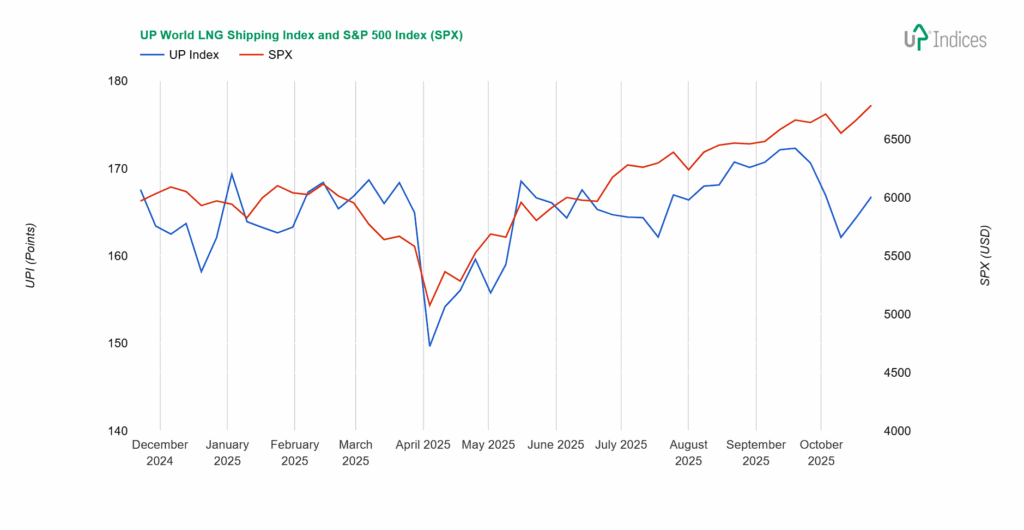
The UP World LNG Shipping Index added 2.39 points (1.45 %), closing at 166.75 points, while the S&P 500 gained 1.92 %. Trading volume picked up, and fourteen of the index’s twenty‑one constituents rose, with a median move of +1.68 %.
The best performer was Korea Line Corporation, up 7.73 %, and MISC also rebounded strongly after a several‑week decline. Four companies gained around 4 %: Shell (+4.48 %), BP (+4.26 %), Tsakos Energy Navigation (+4.16 %) and ADNOC L&S (+4.06 %). Japanese carriers NYK Line (+3.1 %), “K” Line (+3 %) and MOL (+3.4 %) all advanced within sideways ranges, while Nakilat rose 1 %, averting a decline.
On the downside, New Fortress Energy plunged 10.42 %, the only double‑digit move of the week. Excelerate Energy corrected 3.4 %, Capital Clean Energy Carriers slipped 2.6 % and Flex LNG eased 0.64 %.
After rebounding from its long‑term support, the UPI remains within a 161–170 point trading range, and the late‑summer rally has been fully unwound. Short‑term volatility is likely to increase, yet the long‑term outlook for LNG shipping remains constructive.
UPI & SPX
The UP World LNG Shipping Index, which tracks listed LNG shipping companies, gained 2.39 points (1.45%), closing at 166.75 points, while the S&P 500 index gained 1.92%. The chart below illustrates the performance of both indices with weekly data.
Broader View
After rebounding from support, the index returned to the upper part of the long-term range and has since trended sideways, with slightly increased volume. Fourteen companies grew, six fell, and the median movement was +1.68%.
Despite the growth, UPI is moving in a long-term band. This is also reflected in the calmer trading of individual companies.
Constituents
Many of them are moving around support levels, and a large number of them are also trending sideways.
Korea Line Corporation (KRX: 005880) grew the most, by 7.73%. MISC (KLSE: 3816) also showed a nice movement, during which it erased a several-week downward trend and rose to the upper edge of the previous range.
Four companies grew by four per cent. These were Shell (NYSE: SHEL, +4.48%), BP (NYSE: BP, +4.26%), Tsakos Energy Navigation (NYSE: TEN, +4.16%), and
ADNOC L&S (ADX: ADNOCLS, +4.06%). SHEL was the only one to break out of the sideways range and close above it. BP rose from support above the middle of the range, while TEN closed at the support level after a higher rise was rejected earlier. ADNOC is trying to continue its upward trend after a two-week correction.
Japanese companies grew by about 3%. NYK Line (TSE: 9101, +3.1%) and “K” Line (TSE: 9107, +3%) rose within a sideways range, while MOL (TSE: 9104, +3.4%) corrected its previous decline and effectively rose to the former support (now resistance) level of the wide range that formed in 2024.
Nakilat (QSE: QGTS) also rose by one per cent, averting an attempt at a decline.
The declines were only slight, except for New Fortress Energy (NYQ: NFE), which fell 10.42%, the only double-digit movement of the week. Excelerate Energy (NYQ: EE) corrected its growth by 3.4%, while Capital Clean Energy Carriers (NYQ: CCEC), moving sideways, lost 2.6%. Flex LNG (NYSE: FLNG) is also moving sideways, losing 0.64%.
Crystal Ball
The late-summer rise was rejected, and UPI returned to its previous range, where it now trades. This area provides firm support. In the short term, we estimate a rise in volatility of UPI´s constituents.
Our outlook remains steadfastly positive in the long term. The burgeoning demand for LNG, bolstered by situational or management-driven actions and the potential for new long-term contracts, paints a promising picture. Investors should watch policy developments, market competition, and upcoming corporate earnings for further direction.
About UPI
Established in 2020, the UP World LNG Shipping Index is a rules-based stock index family designed to measure the performance of publicly traded companies worldwide involved in the maritime transportation of liquefied natural gas (LNG). This unique index covers 21 companies and partnerships worldwide, representing over 65% of the world’s LNG carrier fleet in 2020. The UP Index provides premium services, offering freemium and trial access to charts. With Freemium, users can access the basic UPI vs. S&P 500 chart after completing an email registration. The trial includes full access for fourteen days.
Final Note
This report primarily relies on technical analysis using weekly data.