
Summary
The UP World LNG Shipping Index fell 3.43 points (1.53%) to close at 221.48, a more moderate retreat than the prior week, while the S&P 500 lost 0.47%. Unlike recent weeks, the internals were soft too: the median fell 1.79% and the weighted index (wUPI) dropped 3.27%, with breadth of 8:13. The dominant story was news flow rather than price: QatarEnergy signed major long-term US supply deals — up to 4 mtpa from Cheniere through 2054, plus advanced talks with Woodside (up to 3 mtpa) and Venture Global — to cover its war-induced liquefaction outages, and the first Qatari cargo since April headed via the Red Sea to Poland’s Świnoujście terminal. ALNG led the gainers (+12%), with Tsakos +4.5% and the oil & gas majors (Chevron +3.65%, BP +2.2%, Shell +1.43%) all at fresh yearly highs. The fallers were led by New Fortress Energy (−16%, new lows), COSCO (−8.37%) and Pan Ocean (−8%), with ADNOC −7.25% and Korea Line −6.8%. In the background, gas prices rose in both basins on colder weather and strong Chinese spot buying — Asian LNG to $30.50/MMBtu, Europe just over $29 — while spot tanker rates firmed on Pacific routes to $30,750 (Atlantic $21,750).
UPI & SPX
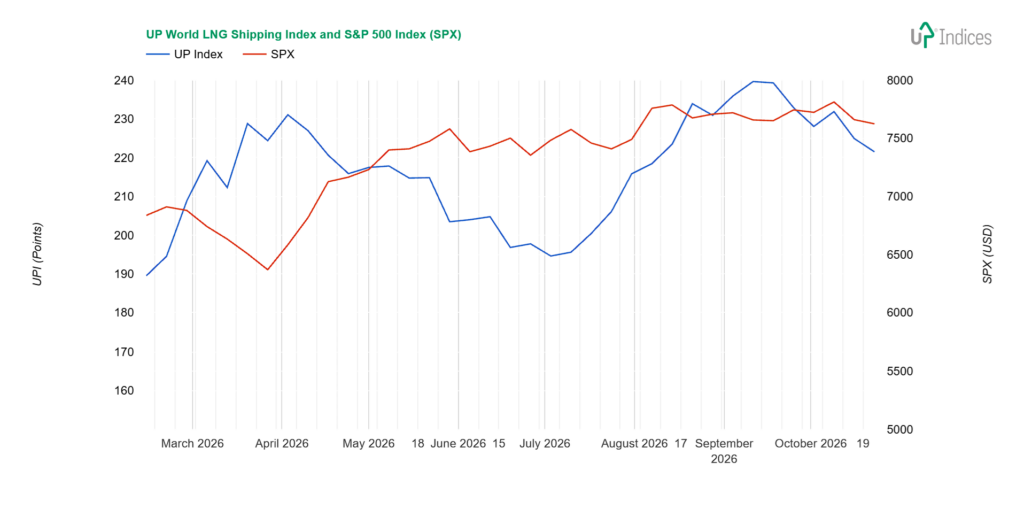
The UP World LNG Shipping Index, which tracks 21 listed LNG shipping companies, lost 3.43 points (1.53%) to close at 221.48 points, while the S&P 500 index lost 0.47%. The chart below illustrates the performance of both indices with weekly data.
Broader view
The UPI continues to fall at a more moderate pace. The median fall was 1.79 per cent, whilst the weighted index (wUPI) fell by 3.27 per cent. The ratio of rising to falling companies was 8:13.
The UPI is being weighed down by uncertainty in the stock market and growing signs of a resumption of US strikes against Iran, while positive factors include the weather, rising demand for gas and, in the longer term, new Qatari contracts for US gas.
Some interesting news emerged at the end of the week. The biggest surprise came in the form of a statement by the former CEO of Polar LNG to the Financial Times, revealing that Russia’s Novatek is behind the Alaskan project.
The second piece of news concerned new LNG supply contracts signed by QatarEnergy with US and Australian companies. QatarEnergy is thus addressing the war-induced outages in its liquefaction capacity.
QatarEnergy has signed two long-term deals to buy up to 4 mtpa of LNG from Cheniere Energy under agreements extending into the second half of the century, according to TradeWinds. Bloomberg first reported the news.
Reuters reported on the second contract with the Australian company Woodside. A long-term deal could cover up to 3 million metric tonnes a year for 15 to 20 years, according to one source. Woodside’s Louisiana LNG plant, currently under construction, has an export capacity of 16.5 mtpa. QatarEnergy also holds a 70 per cent stake in the Golden Pass LNG facility being developed in Louisiana, which, when complete, will have the capacity to export up to 18 mtpa of LNG.
Louisiana LNG is said to be asking for a premium on liquefaction fees exceeding $2.50 per mmBtu and above average US market prices due to contractual flexibility, offering potential buyers shorter contracts in return for higher prices, two people told Reuters.
Reuters also reported on Thursday that QatarEnergy is in advanced talks with Venture Global (VG.N), opens new tab, regarding a long-term supply deal to purchase at least 3 million metric tonnes of LNG per year.
Thirdly, Energy Intelligence reported on Qatari gas heading via the Red Sea to Poland. This is the first shipment since April. It is a Qatar-Max-sized tanker. It is worth recalling a piece of information a Czech expert shared with me. Originally, the Nord Stream pipeline was to be constructed in such a way as to prevent these ships from reaching Poland. However, the Poles realised this in time, and the Russians had to make adjustments. Energy decisions have long-term implications.
The vessel’s latest Automatic Identification System (AIS) signal listed Poland’s Świnoujście import terminal as its destination, with an estimated arrival date of 14 November. This suggests the cargo is being delivered to the Polish firm Orlen under its long-term contract with QatarEnergy.
However, the apparent delivery raises further questions, given that Orlen’s two separate long-term contracts with QatarEnergy are understood to remain under force majeure. The Qatari state exporter declared force majeure following the outbreak of the Gulf War and subsequent drone attacks against its Ras Laffan industrial complex in March. LNG imports from Qatar accounted for less than 10 per cent of the demand generated by Orlen and its gas customers in 2025, the company told Energy Intelligence earlier this year.
A weekly Reuters round-up reported on rising gas prices in both Asia and Europe, driven by cooler weather as well as higher consumption and demand:
Asian LNG prices rose to $30.50 per MMBtu, whilst European prices climbed to just over $29 per MMBtu.
“Colder weather forecast across Europe in early November could accelerate storage withdrawals. Northeast Asia also faces colder-than-normal forecasts, although ample inventories should limit near-term LNG competition, with risks shifting towards later months as stocks decline,” said Kesher Sumeet, senior analyst at Energy Aspects.
Asian demand has risen more sharply than European demand this week, intensifying competition between basins, said Martin Senior, head of LNG pricing at Argus.
Chinese spot demand has been strong over the past week, with the state-owned CNOOC purchasing at least 11 cargoes and negotiating for further volumes in November and December to meet storage targets, whilst South Korea’s Kogas was also seeking volumes, he added.
China has already experienced a sharp drop in temperatures in its northern and north-eastern regions, with temperatures forecast to fall across its central and eastern areas, whilst South Korea is also seeing colder air moving in, said Rystad Energy analyst Mathieu Utting in a note.
“If this cooling proves sustained, spot LNG buying from China and South Korea will accelerate, and European buyers will need to raise their bids to secure the Atlantic cargoes they are counting on for the winter,” he said.
European LNG markets rose over the week amid geopolitical developments in the Middle East, Norwegian pipeline outages and demand from Egypt, which is seeking five LNG cargoes for delivery in November, said Aly Blakeway, head of Atlantic LNG at S&P Global Energy.
Spot rates rose mainly for Pacific routes, reaching $30,750 per day. Atlantic rates stood at $21,750, according to Spark Commodities.
According to our UPI TCE, the average UPI contracts are now around $70,000 per day.
Constituents
The only double-digit gain last week was posted by ALNG (OSE: ALNG), which rose by 12 per cent. This represented a move from the lower end of the trading range to the upper end, accompanied by above-average trading volume. It must be acknowledged, however, that the average trading volume is quite low.
The second-highest gain was just 4.5 per cent, posted by Tsakos Energy Navigation (NYSE: TEN). This move also took the price to the upper edge of the range and above the resistance level of the closing prices, although it ended at a key resistance level. Compared with the negative candlestick of the week before last, this is a positive candlestick (with a shadow). However, volume was only average.
The trio of oil and gas companies, which also operate in the complementary LNG maritime transport sector, took the next three places in the growth rankings. Compared with the week before last, the gains were smaller. Chevron (NYSE: CVX) gained 3.65 per cent, BP (NYSE: BP) rose by 2.2 per cent and Shell (NYSE: SHEL) by 1.43 per cent. Nevertheless, all three have reached new highs for the year, well above their spring prices. Trading volumes were average to slightly below average.
FLEX LNG (NYSE: FLNG) posted the only gain of more than one per cent. Although small in percentage terms, this rise is significant as it occurred at a support level following a break below the $30 mark. During the week, FLNG corrected further, down to $27, but ultimately returned above $28.50. This is a level identified and confirmed in February, July and now.
Golar LNG (NASDAQ: GLNG) showed the latest positive movement. The 0.77 per cent rise followed a similar pattern to FLNG, though the support level is not as clearly visible. The price entered the range of summer 2025 prices but remained at its upper limits, perhaps even just above them. This level has therefore been rejected for now; we will see whether it rises to the $50 mark.
Paradoxically, Dynagas LNG Partners (NYSE: DLNG) confirmed its previous 3.3 per cent decline with a 0.6 per cent rise.
New Fortress Energy (NASDAQ: NFE) once again leads the fallers, having lost 16 per cent and hit new lows.
There were two shares down by 8 per cent: COSCO Shipping Energy Transportation (SS: 600026; -8.37 per cent) and Pan Ocean (KRX: 028670; -8 per cent). Whilst Pan Ocean corrected its previous break above resistance by returning to its upper boundary, COSCO is correcting its previous rise for the second week running. The question is whether the rise itself was a correction and the trend is now continuing downwards, as there are several possible interpretations. On the one hand, the price has fallen out of the sideways range seen in the spring (negative view); on the other hand, this may be a continuation of the downtrend from the spring (a lower high has formed, negative view), or it may be a correction within an uptrend, after which the price will return to those spring levels (positive view). We do not know and will leave further developments to the market.
ADNOC Logistics & Services (ADX: ADNOCLS) fell 7.25 per cent, ending its clearly positive run with a pullback to a lower level. Even so, the overall trend remains positive, and the decline may not continue.
Korea Line Corporation (KRX: 005880) broke out of its sideways range by breaching support. It fell by 6.8 per cent.
MISC (KLSE: 3816; -5.3 per cent) saw a correction following the previous week’s gains. The decline was somewhat mitigated, but the share price remained, albeit just barely, within the summer’s sideways trend.
Nakilat (QSE: QGTS; -3.71 per cent) and Exmar (EBR: EXM; -3 per cent) both fell by three per cent. We have covered the development of Qatari exports in sufficient detail in the previous section. Nakilat fell but staged a positive recovery, so the decline was not as severe as during the week. Nevertheless, it remains within the price range seen in 2023. Exmar continues its sideways trend slightly below its highest prices.
Excelerate Energy (NYSE: EE) once again found support at $32.4. The decline was 2.4 per cent.
The Japanese trio continues to perform similarly, with losses of around 1.85 per cent. NYK Line (TSE: 9101), Mitsui O.S.K. Lines (TSE: 9104) and “K” Line (TSE: 9107) continue to move sideways near their highs for the year.
Capital Clean Energy Carriers (NASDAQ: CCEC) is also trading near support within a sideways range. The share price fell by 0.7 per cent.
Crystal Ball
Qatar remains sidelined among the conflict’s losers — but the key constraint is export, not production. The damage to Ras Laffan removed around 17% of capacity (two of 14 trains), which QatarEnergy expects to take three to five years to repair. The remaining ~80% of capacity is intact and could, in principle, return to market — but the Strait of Hormuz is Qatar’s sole export route, and executives (including Shell’s) caution that even a reopening would not restore pre-war flows overnight, as high war-risk insurance continues to deter tanker returns to the Gulf. For now, this keeps a large share of Qatari volume bottled up, and US LNG exporters emerge as the clear winners. European importers were shielded from spot price increases largely because of long-term US contracts; however, these are not enough to replenish winter inventories, and European companies must return to the market despite Qatar’s continuing export restrictions. We expect most of the rising US gas production to flow toward Europe. New global LNG producers should also benefit, as energy source diversification becomes more important than ever — provided importing economies remain healthy enough to absorb higher energy costs. The outlook remains volatile, but positive in the long term. The gradual phasing out of steam vessels and the addition of new liquefaction capacity will continue to drive the sector forward.
About UPI
Established in 2020, the UP World LNG Shipping Index is a rules-based family of stock indices designed to measure the performance of publicly traded companies worldwide engaged in the maritime transportation of liquefied natural gas (LNG). This unique index comprises 21 companies and partnerships worldwide, representing more than 65% of the global LNG carrier fleet in 2020. The UP Index provides premium services, offering freemium and trial access to charts. With the Freemium plan, users can access the basic UP Index vs S&P 500 chart after completing email registration. The trial includes full access for fourteen days.
Final Note
This report primarily relies on technical analysis using weekly data. The summary section is AI-generated.
Disclosure: The author holds beneficial long positions in the shares of ALNG, FLNG, and NFE, whether through share ownership, options, or other derivatives. This report was prepared in-house and reflects our own opinions. We have received no compensation for it and have no business relationship with any company whose shares are mentioned herein.
Disclaimer: This report is provided for informational purposes only and does not constitute investment advice, nor a recommendation or solicitation to buy or sell any securities. It relies primarily on technical analysis using weekly data. Readers should conduct their own research and consult a qualified financial adviser before making any investment decisions.