
Summary
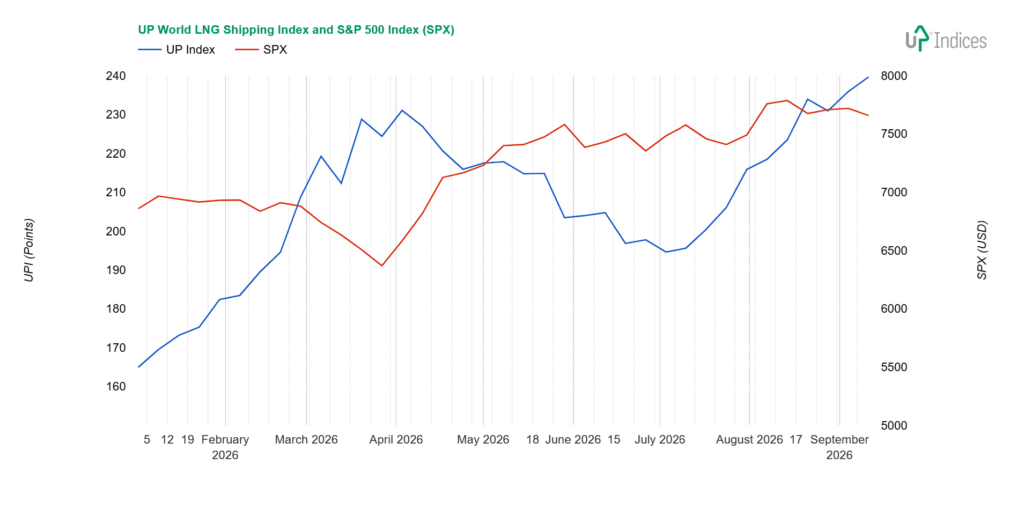
The UP World LNG Shipping Index gained 3.75 points (1.59%) last week, closing at a new all-time high of 239.62 points, while the S&P 500 lost 0.80%. The UPI’s rise was driven by 16 companies, with 4 falling and 1 unchanged; the median gain was 2.07%, and the weighted index rose 0.6%. Company-specific news dominated the week: New Fortress Energy surged 20.44% on completing its restructuring and 50:1 share consolidation, while Tsakos Energy Navigation rose 9.51% on the prospect of a dividend increase. Gas prices rose in both Europe and Asia — European prices reached their highest intraday levels since late December 2022 — while spot tanker rates remain low. ADNOC Logistics & Services (+6.84%) and the oil majors also advanced, supported by renewed US–Iran tensions.
UPI & SPX
The UP World LNG Shipping Index, which tracks 21 listed LNG shipping companies, gained 3.75 points (1.59%), closing at 239.62 points, while the S&P 500 index lost 0.80%. The chart below illustrates the performance of both indices with weekly data.
Broader View
The UPI continues to rise, driven by 16 companies. Four fell, and one remained unchanged. The median gain was 2.07 per cent, whilst the weighted index (wUPI) rose by 0.6 per cent. Trading volume remained slightly above average.
The gas market situation has deteriorated slightly, driven by worsening geopolitical conditions and the passage of time. Gas prices have risen in both Europe and Asia.
Reuters in its weekly report quoted Martin Senior, head of LNG pricing at Argus: „Bangladesh and South Korea were the main Asian buyers of spot cargoes over the past week, with Kogas purchasing around 14 to 20 cargoes for delivery between November and January, and Bangladesh buying 20 cargoes for delivery between October and June.“
In Europe, gas prices hovered slightly above €80, reaching their highest intraday levels since late December 2022, Reuters said.
The bullish momentum is likely to extend into next week, as ongoing planned maintenance in Algeria, Norway and the Belgium-UK interconnector will continue to restrict pipeline supply into the EU, whilst LNG imports are expected to edge lower amid emerging competition from Asia, said Kpler’s Pinto.
Spot rates for LNG tankers remain low, at $20,000 per day for the Atlantic and $24,000 per day for the Pacific, according to Spark Commodities.
Constituents
Most companies saw relatively small price movements, with a few exceptions.
These were mainly New Fortress Energy (NASDAQ: NFE; +20.44 per cent) and Tsakos Energy Navigation (NYSE: TEN; +9.51 per cent).
New Fortress Energy rose after announcing the successful completion of its restructuring and re-capitalisation, including the effective date of the restructuring and a 50:1 share consolidation, which shareholders approved in June. As part of the restructuring, the Brazilian operations are being spun off into a separate company (BrazilCo) and ‘New NFE’ is being formed.
Existing creditors (plan creditors) will receive all of BrazilCo’s equity, 65 per cent of New NFE’s ordinary share capital, senior shares with a liquidation preference of US$2.45 billion, and term loans, thereby cancelling third-party debt of approximately US$5.7 billion. Although this will significantly dilute existing shareholders’ stakes, the market has welcomed the resolution of long-standing uncertainty, including repeated warnings from the NASDAQ stock exchange about the company’s low share price. Trading in the old shares has been suspended, whilst trading in the new shares will commence on Monday 14 September.
Tsakos rose on Friday following the CEO’s mention of a likely dividend increase due to improved financial results, which was announced during the second-quarter conference call. On Friday, the share price broke through resistance and, on above-average volume, closed at levels last seen in 2015.
ADNOC Logistics & Services (ADX: ADNOCLS; +6.84 per cent) posted a rise of nearly seven per cent. It, too, easily broke through short-term resistance.
Tensions between the US and Iran are also bolstering the oil and gas trio. BP (NYSE: BP) rose by 5.23 per cent, though the earlier announcement of a new CEO also played a part. Shell (NYSE: SHEL) rose by 4.11 per cent and Chevron (NYSE: CVX) by 2.62 per cent. BP remains sideways and is just approaching resistance; Chevron broke through it but stayed right on the edge of the magnetic resistance level, so only Shell managed to capitalise on the situation and achieve unequivocally positive growth.
Exmar (EBR: EXM) rose by 3.46% after signing a contract with Colombia for its FSU Tura. The Tura is a converted first-generation LNG tanker acquired from the Maran Nakilat consortium.
Dynagas LNG Partners (NYSE: DLNG) rose 3.3 per cent, although it has traded sideways even after its second-quarter results.
COSCO Shipping Energy Transportation (SS: 600026) rose by 2.56 per cent, whilst the weekly tra-ding range was significantly wider.
The share price has yet to return to its spring range, nor has it fallen back to its summer levels.
The Japanese trio is, of course, feeling currency pressures, yet it has been gaining ground within the upper end of its trading
range. “K” Line (TSE: 9107) gained 2.1 per cent, NYK Line (TSE: 9101) rose by 1.5 per cent, and Mitsui O.S.K. Lines (TSE: 9104) rose by 1.1 per cent. All three saw a wider trading range over the week.
It is also worth noting the last three gains, even if the figures do not appear particularly significant. However, these rises are toward or at resistance levels, and such movements are almost always of interest. The 1.5 per cent rise in Golar LNG (NASDAQ: GLNG) is interesting precisely be-cause of its unassuming nature. The price is already trading above the resistance level marked by the candle bodies. Still, it remains under the influence of the magnetic resistance formed by the highest prices, as well as the candle bodies from the spring rally and the subsequent sideways trend. The path upwards to new highs will not be easy, but reaching at least the spring price le-vels is just a small step away – and it is precisely this magnetic resistance that stands in the way.
FLEX LNG (NYSE: FLNG) is in a similar situation, though it is significantly closer to those highs.
‘Only’ magnetic resistance is preventing Pan Ocean (KRX: 028670, +1.2 per cent) from reaching new highs. These are levels where the price has repeatedly been swiftly rejected.
The biggest decline wasn’t much, at 4 per cent for Excelerate Energy (NYSE: EE). And this decline occurred precisely from the magnetic resistance zone.
Capital Clean Energy Carriers (NASDAQ: CCEC) has moved into the sideways range – or rather, to its lower edge – following a 1.5 per cent decline.
NAKILAT (QSE: QGTS; -1%), a company severely affected by the ongoing conflict, is also heading towards the support level within its range.
The second South Korean company in the index, Korea Line Corporation (KRX: 005880; -0.7%), is waiting for a second week for the rally to continue. We will soon see whether this happens.
Crystal Ball
Qatar has been temporarily sidelined among the conflict’s losers because of industrial damage to its facilities, and the UAE seems to také its position. U.S. LNG exporters emerge as the clear winners. European importers were shielded from spot price increases thanks to predominantly long-term U.S. contracts. However, these contracts are not sufficient to replenish inventories for the winter, and European companies must return to the market despite Qatar’s continuing export restrictions. We expect most of the rising US gas production will flow towards Europe. New global LNG producers should also benefit from this conflict, as energy source diversification becomes more important than ever—provided importing economies remain healthy enough to absorb higher energy costs.
The outlook remains volatile, but positive in the long term. The gradual phasing out of steamers and the addition of new liquefaction capacity will continue to drive the sector forward.
About UPI
Established in 2020, the UP World LNG Shipping Index is a rules-based family of stock indices designed to measure the performance of publicly traded companies worldwide engaged in the maritime transportation of liquefied natural gas (LNG). This unique index comprises 21 companies and partnerships worldwide, representing more than 65% of the global LNG carrier fleet in 2020. The UP Index provides premium services, offering freemium and trial access to charts. With the Freemium plan, users can access the basic UP Index vs S&P 500 chart after completing email registration. The trial includes full access for fourteen days.
Final Note
This report primarily relies on technical analysis using weekly data. The summary section is AI-generated.
Disclosure: The author holds beneficial long positions in the shares of ALNG, FLNG, GLNG and NFE, whether through share ownership, options, or other derivatives. This report was prepared in-house and reflects our own opinions. We have received no compensation for it and have no business relationship with any company whose shares are mentioned herein.
Disclaimer: This report is provided for informational purposes only and does not constitute investment advice, nor a recommendation or solicitation to buy or sell any securities. It relies primarily on technical analysis using weekly data. Readers should conduct their own research and consult a qualified financial adviser before making any investment decisions.