
Summary
The UP World LNG Shipping Index fell 9.91 points (4.56%) to close at 207.23, swept up in a broad global sell-off — the S&P 500 lost 8.61%, its worst week since April 2025, on a sharp shift in sentiment toward technology shares. The UPI fell less than the S&P, partly because its Asian constituents had already closed before the worst of the US session; the median dropped 5.24% and the weighted index (wUPI) 2.5%, on well-below-average volume. Only four names rose, led by ADNOC (+8.75%) rebounding off support toward its all-time highs, with Korea Line +2%, Nakilat just under 1% and COSCO +0.61%. The damage was led by Capital Clean Energy Carriers (−14.21%, breaking two support levels in the broad sell-off despite a strong Q3), with Excelerate (−11.13%) and Tsakos (−10.2%) also down double digits, and FLEX LNG (−9.73%) and Golar (−9.16%) closing behind. In the background, the gas market calmed: Asian and European prices both eased and converged near $26.8/MMBtu as Hormuz flows continued and Asian inventories stayed comfortable. Qatar kept signing US supply deals — potentially a quarter of new global supply by 2030 — and a new, likely non-oil-indexed Orlen contract is being drawn up to replace the terminated 2009 deal. Spot tanker rates fell to $20,000 (Atlantic) and $52,000 (Pacific).
UPI & SPX
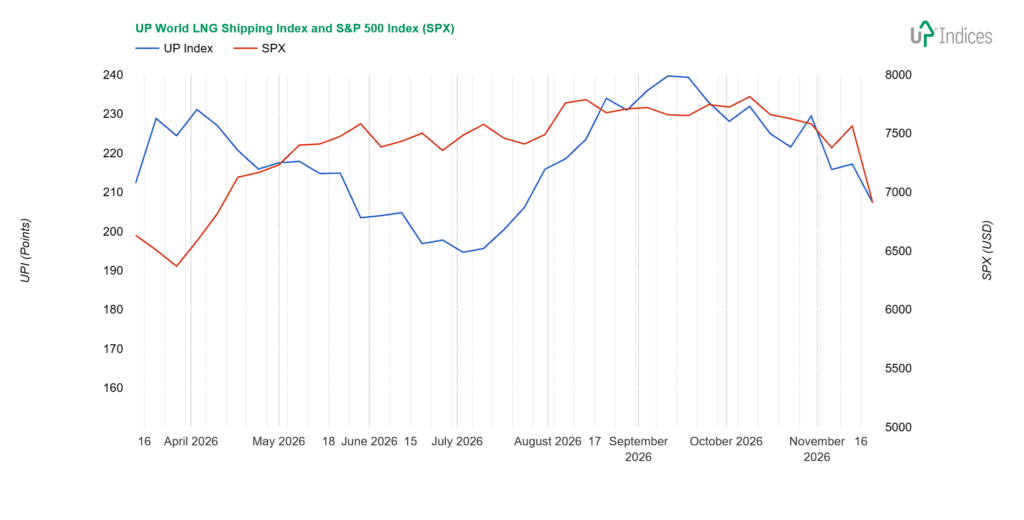
The UP World LNG Shipping Index, which tracks 21 listed LNG shipping companies, lost 9.91 points (4.56%) to close at 207.23 points, while the S&P 500 index lost 8.61%. The chart below illustrates the performance of both indices with weekly data.
Broader View
The UPI, like most equity markets, continued to fall, driven by a shift in sentiment towards technology shares. The chart shows that the S&P 500 index fell more sharply than the UPI. This is to some extent due to the UPI’s global scope, as Asian markets had already closed by the time the US trading session began.
The median change was -5.24 per cent, whilst the weighted wUPI index fell by 2.5 per cent. Trading volume was well below average.
In the LNG market, Qatar’s efforts to minimise losses and maximise potential continue. Qatar thus continued to sign contracts for US gas, with global Qatari supplies potentially accounting for a quarter of new global supplies by around 2030. Qatar is thus capitalising on what it does not offer its customers – the freedom to dispose of the gas they purchase as they see fit, i.e. the ability to change the final destination according to current market conditions. Qatari customers must unload the gas at the location they specified at the time of loading.
Both Reuters and Bloomberg also reported on the background to the recent termination of the long-term contract between Poland’s Orlen and QatarEnergy: a new contract is being drawn up, in which the price of gas will likely no longer be linked to the price of oil, as was the case in the original 2009 contract. This is therefore not a matter of a loss of confidence in Qatari supplies, but primarily a question of price, with Orlen having invoked force majeure to suspend deliveries.
The Reuters weekly round-up states that the situation on the gas market has calmed down over the past week. Prices fell for both Asia ($26.90 per MMBtu) and Europe ($26.75 per MMBtu). Thus, there was not only a fall in prices but also a levelling out.
“Continued LNG flows through the Strait of Hormuz and comfortable Asian inventories that limit spot buying interest are easing market pressures,” said Ole Dramdal, senior analyst at Rystad Energy.
Some buying interest, however, was visible in South and South-East Asia, he said, with Thailand, Pakistan and Vietnam showing buying interest.
“In north-east Asia, buyers have stepped back from the spot market, with Chinese firms purchasing only enough to meet storage targets, South Korean buyers already covered for winter, and Japanese demand well supplied by long-term contracts,” said Martin
Senior, head of LNG pricing at Argus.
“European LNG prices fell sharply over the week as improving global supply expectations and weak Asian competition outweighed tightening European winter fundamentals,” said Aly Blakeway, head of Atlantic LNG at S&P Global Energy, adding that US feedgas at near-record levels pointed to strong export availability from the Atlantic Basin: “Middle Eastern supply also continued its gradual recovery. Qatar and Abu Dhabi exported around one cargo per day during the first half of November.”
Spot rates for LNG tankers fell to $20,000 for the Atlantic and $52,000 for the Pacific, according to Spark Commodities.
Constituents
In the previous paragraph, we mentioned the growth in exports through the Strait of Hormuz. This had a positive impact on ADNOC Logistics & Services (ADX: ADNOCLS), which posted the biggest gain of the past week: +8.75 per cent. It thus capitalised on the halt at the support level we mentioned, erasing several weeks’ worth of losses in a single week and returning to within striking distance of its all-time highs.
The second-largest gain was recorded by Korea Line Corporation (KRX: 005880), which rose by two per cent and continues to trade sideways.
NAKILAT (QSE: QGTS) rose by just under one per cent (UPI is calculated based on Friday’s prices). It thus maintained the price levels seen over the summer, when the ceasefire agreement was in place.
The final gain was recorded by COSCO Shipping Energy Transportation (SS: 600026; +0.61 per cent). In its case, this represents a slowdown in the decline, though it is as yet difficult to judge how this will play out. As we have previously noted – and the situation remains unchanged – we are unsure whether this is a correction following a rise or a continuation of the downtrend. We’ll have a clearer picture once the price reaches 14 or 26 yuan.
The declines are primarily linked to developments in the broader equity and commodities markets, which can be described as extraordinary. Nevertheless, the price levels reached allow us to assess and update the areas of interest to investors.
The biggest fall of the week was seen in Capital Clean Energy Carriers (NASDAQ: CCEC; -14.21 per cent). The share price broke through two support levels in one go, thereby bringing the previous sideways trend to a decisive end. Although the price had already been in these regions earlier this year, it had never closed so low. And it certainly hadn’t fallen there so quickly. The drop looks sentiment- and valuation-driven within the broader sell-off; there was no company-specific news to explain its magnitude, and CCEC’s Q3 was in fact strong.
Excelerate Energy (NYSE: EE; -11.13 per cent) and Tsakos Energy Navigation (NYSE: TEN; -10.2 per cent) also fell by over ten per cent.
Excelerate Energy ended its attempt at an uptrend by returning to a sideways range, whilst Tsakos broke below its autumn highs and entered the subsequent price range seen during the summer, giving it sufficient room to manoeuvre.
Two companies with similar ticker symbols also fell by just under ten per cent: Flex LNG (NYSE: FLNG; -9.73 per cent) and Golar LNG (NASDAQ: GLNG; -9.16 per cent).
Flex cut through the $25 level like a knife through butter and closed a further two dollars lower. This now appears to be the optimal zone; after all, the annual dividend yield at these prices, with the nearest ex-date on 27 November, exceeds 12 per cent. EPS for the third (record-breaking) quarter covers this dividend. Paradoxically, a fall and a continued stay at this level even after the New Year could prompt management to adjust the dividend downwards, should they deem a dividend yield above 10 per cent to be too high. This could thus be a self-fulfilling prophecy, but one that would certainly stabilise the FLNG share price and restore its reputation as an equity bond.
Golar’s share price looks similar; it too has returned to the range-bound trading seen in 2025 and 2026. Trading volume was well above average for both stocks, linked to support-level breaks and updated market sentiment.
Another pair lost over six per cent: BP (NYSE: BP; -6.46 per cent) and Dynagas LNG Partners (NYSE: DLNG; -6.33 per cent).
BP is in a congested zone, whilst Dynagas, despite solid quarterly results, dipped below its previous support level, as the weekly price action showed a narrow short-term sideways range. However, the price remained within the magnetic support formed by the shadow.
No fewer than four companies fell by five per cent: ALNG (OSE: ALNG; -5.8 per cent), Mitsui O.S.K. Lines (TSE: 9104; -5.6 per cent), Shell (NYSE: SHEL; -5.55 per cent) and Chevron (NYSE: CVX; -5.24 per cent).
ALNG continues to trade sideways following its quarterly results. Of particular interest is the signing of contracts for both tankers, which had previously been operating on the spot market. If we can expect a typical price, it could range between 50,000 and 75,000 dollars, although management emphasised, above all, a higher utilisation rate than the current 73 per cent. The core focus, however, remains the expansion of operations to include gas trading, on which there is as yet no new news.
MOL, like the other two Japanese companies, has held its previous support level and thus retained scope for an upward move.
Chevron is in a similar situation to BP, but Shell is now more akin to the Japanese trio. It has also held within a range from which, given favourable conditions, it can envisage growth somewhat more easily than BP and Chevron.
NYK Line (TSE: 9101) and “K” Line (TSE: 9107), the remaining members of the Japanese trio, fell by around 4 per cent.
Exmar (EBR: EXM) fell by 3.42 per cent and remains in a sideways trend.
MISC (KLSE: 3816) lost 2 per cent; it remains near its support level, and only the reaction following the market open will reveal more.
Pan Ocean (KRX: 028670) held steady at support, which roughly marks the low point of this year’s price movement.
New Fortress Energy (NASDAQ: NFE) remained unchanged compared with the week before last, although it tested moves in both directions during the week.
Crystal Ball
Qatar remains on the sidelines among the losers of this conflict, yet its actions over the past few weeks have boosted market optimism, deepened by new U.S. contracts. Its efforts to honour its commitments and fulfil its orders are undoubtedly a significant boost to its customers. US producers are seeking to capitalise on the resulting vacuum by accelerating capacity expansion as supplier diversification takes place. Price is no longer the sole criterion, and even Bangladesh has announced that it has signed a long-term contract with a US producer.
Whilst the coming winter months will bring increased uncertainty and a scramble for gas – partly due to the uncertain geopolitical situation, with a significant risk of further US strikes on Iran – we expect the situation to stabilise and adapt in the spring, primarily through the diversification of suppliers.
About UPI
Established in 2020, the UP World LNG Shipping Index is a rules-based family of stock indices designed to measure the performance of publicly traded companies worldwide engaged in the maritime transportation of liquefied natural gas (LNG). This unique index comprises 21 companies and partnerships worldwide, representing more than 65% of the global LNG carrier fleet in 2020. The UP Index provides premium services, offering freemium and trial access to charts. With the Freemium plan, users can access the basic UP Index vs S&P 500 chart after completing email registration. The trial includes full access for fourteen days.
Final Note
This report primarily relies on technical analysis using weekly data. The summary section is AI-generated.
Disclosure: The author holds beneficial long positions in the shares of ALNG, EXM, FLNG, and NFE, whether through share ownership, options, or other derivatives. This report was prepared in-house and reflects our own opinions. We have received no compensation for it and have no business relationship with any company whose shares are mentioned herein.
Disclaimer: This report is provided for informational purposes only and does not constitute investment advice, nor a recommendation or solicitation to buy or sell any securities. It relies primarily on technical analysis using weekly data. Readers should conduct their own research and consult a qualified financial adviser before making any investment decisions.