
Summary
The UP World LNG Shipping Index rose 3.84 points (1.68%) to close at 231.87, while the S&P 500 gained 1.15%. The advance was broad but gentle: breadth was 11:10, the median constituent rose 2.3%, and while the weighted index (wUPI) eased less than half a per cent, the overall tone pointed to stabilisation rather than a strong directional push. Volume ticked up from the prior week but stayed on the lower side. COSCO led with a double-digit, trend-following gain (+14%) back into the spring range, Excelerate added 6.8% off support, and ADNOC rose 6.7% to erase its two-week correction. Shell broke to fresh highs (+4%), with BP, Chevron, Tsakos and the Japanese trio all gaining within their sideways ranges. On the downside, New Fortress Energy slid over 33% to new lows, and Nakilat eased 2.88% on geopolitics, while both Korean names and Dynagas gave back recent gains. In the background, Asian spot LNG firmed on renewed tanker-attack fears near Hormuz, though muted Chinese and Indian buying capped the rise; Hormuz flows stayed strong (9 carriers reactivating AIS east of the strait this month).
UPI & SPX
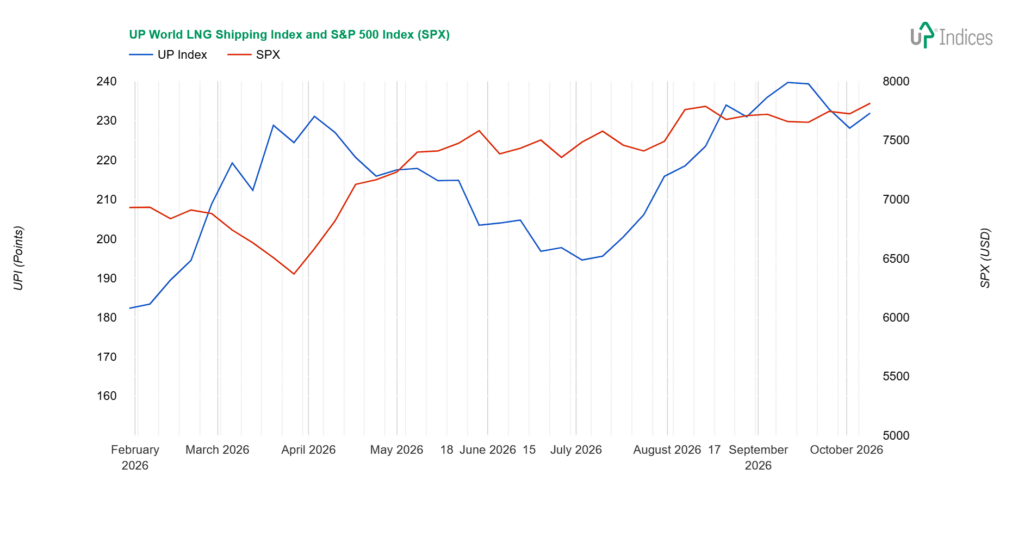
The UP World LNG Shipping Index, which tracks 21 listed LNG shipping companies, gained 3.84 points (1.68%) to close at 231.87 points, while the S&P 500 index gained 1.15%. The chart below illustrates the performance of both indices with weekly data.
Broader View
UPI strengthened after returning to the spring range. The ratio of rising to falling components was 11:10, and the median movement was 2.3%—meanwhile, the Weighted Index (wUPI) weakened by less than half a per cent. Traded volume was higher than the week before last, but it was still among the lower levels. Together, this data may indicate stabilisation of the index and a lack of strength for further upward or downward movement. The results for the third quarter will also come into play soon, where companies that have 1) spot-traded ships (still slightly positive) and 2) a share in gas trading (positive) may surprise.
Reuters’ weekly summary reports that Asian spot LNG prices rose this week as renewed attacks on tankers near the Strait of Hormuz stoked concerns over potential supply disruptions, although muted buying interest from key importers, including China and India, limited gains.
Martin Senior, head of LNG pricing at Argus, said prices have risen over the past week because of an increase in tensions between the US and Iran, as well as increased ship attacks – one on an LNG carrier – which have weighed on Hormuz transit expectations.
“Still, flows through Hormuz have been strong, with 9 carriers so far this month turning their AIS transponders on east of Hormuz after a likely transit. And there have likely been 4 ship-to-ship transfers in the Gulf of Oman this week. This has continued to weigh on South Asian spot demand,” he added.
Northeast Asian spot demand has been quiet in recent weeks, with inventories viewed as ample heading into winter. Indian spot demand remains muted relative to a month earlier, because of the increased Hormuz transits, Senior said.
Spot rates for LNG tankers for the Atlantic fell to $21,000 and remained at $39,000 for the Pacific, according to Spark Commodities.
Constituents
We assessed the week before last as positive, and the same tone, also in UPI’s statement, held last week.
Several stocks bounced off support and rose within the range; some strengthened above resistance or continued the growth trend.
Here, the growth of COSCO Shipping Energy Transportation (SS: 600026) is undoubtedly worth mentioning. It posted double-digit, trend-following gains. After a 14% gain, the price reached the spring range.
Excelerate Energy (NYSE: EE) added 6.8% after bouncing off support, confirming the importance of this level.
ADNOC Logistics & Services (ADX: ADNOCLS) showed very nice growth. It erased a two-week correction decline and strengthened by 6.7% to the magnetic resistance of the highest prices.
Shell (NYSE: SHEL) also grew to new highs this year. The 4% gain was enough to break through the line smoothly, something the stock had been preparing for for about a month.
Its peers in the industry, BP (NYSE: BP) and Chevron (NYSE: CVX), gained 3.26% and 2.56%, respectively, but their gains were still in a sideways range, and any potential breakout will come later.
Japanese companies – NYK Line (TSE: 9101), Mitsui O.S.K. Lines (TSE: 9104) and “K” Line (TSE: 9107) – gained in their sideways range and are still awaiting a breakout similar to Shell’s. Their gains were 2.3-3.2%.
Tsakos Energy Navigation (NYSE: TEN) is also preparing to attempt a further rise to new highs, having gained 2.7% last week and approaching the upper edge of its sideways range.
MISC (KLSE: 3816) used the support to gain 0.8%, compensating for the previous one-week decline.
The decline in New Fortress Energy (NASDAQ: NFE) and, given the geopolitical situation, Nakilat (QSE: QGTS) will not come as a surprise. NFE is looking for new lows, having lost over 33% last week. Nakilat is acting more cautiously; it fell only 2.88%, but the price is still close to the short-term low reached in March this year.
Both Korean companies also weakened. Korea Line Corporation (KRX: 005880) fell 5.6% but is moving sideways. Pan Ocean (KRX: 028670) fell less, down 3.4%, but remains at resistance below its recent highs, where it rose sharply the week before last. A breakout attempt could come soon.
Dynagas LNG Partners (NYSE: DLNG) fell 4.5%, giving back the gains from the week before last. The trend is sideways.
After a promising week two weeks ago, Golar LNG (NASDAQ: GLNG) fell 2.6% and fell back to support.
Capital Clean Energy Carriers (NASDAQ: CCEC) lost only 1.7% numerically, but its stock is acting a bit wildly. It has bounced off the sideways-trend support, but selling pressure seems to persist.
Exmar (EBR: EXM) shows the same loss; it continues sideways.
Two Norwegian companies continue sideways: FLEX LNG (NYSE: FLNG) stays above the $30 level after losing 1.3%, and ALNG (OSE: ALNG) lost 0.3%.
Crystal Ball
Qatar remains sidelined among the conflict’s losers — but the key constraint is export, not production. The damage to Ras Laffan removed around 17% of capacity (two of 14 trains), which QatarEnergy expects to take three to five years to repair. The remaining ~80% of capacity is intact and could, in principle, return to market — but the Strait of Hormuz is Qatar’s sole export route, and executives (including Shell’s) caution that even a reopening would not restore pre-war flows overnight, as high war-risk insurance continues to deter tanker returns to the Gulf. For now, this keeps a large share of Qatari volume bottled up, and US LNG exporters emerge as the clear winners. European importers were shielded from spot price increases largely because of long-term US contracts; however, these are not enough to replenish winter inventories, and European companies must return to the market despite Qatar’s continuing export restrictions. We expect most of the rising US gas production to flow toward Europe. New global LNG producers should also benefit, as energy source diversification becomes more important than ever — provided importing economies remain healthy enough to absorb higher energy costs. The outlook remains volatile, but positive in the long term. The gradual phasing out of steam vessels and the addition of new liquefaction capacity will continue to drive the sector forward.
About UPI
Established in 2020, the UP World LNG Shipping Index is a rules-based family of stock indices designed to measure the performance of publicly traded companies worldwide engaged in the maritime transportation of liquefied natural gas (LNG). This unique index comprises 21 companies and partnerships worldwide, representing more than 65% of the global LNG carrier fleet in 2020. The UP Index provides premium services, offering freemium and trial access to charts. With the Freemium plan, users can access the basic UP Index vs S&P 500 chart after completing email registration. The trial includes full access for fourteen days.
Final Note
This report primarily relies on technical analysis using weekly data. The summary section is AI-generated.
Disclosure: The author holds beneficial long positions in the shares of ALNG, FLNG, and NFE, whether through share ownership, options, or other derivatives. This report was prepared in-house and reflects our own opinions. We have received no compensation for it and have no business relationship with any company whose shares are mentioned herein.
Disclaimer: This report is provided for informational purposes only and does not constitute investment advice, nor a recommendation or solicitation to buy or sell any securities. It relies primarily on technical analysis using weekly data. Readers should conduct their own research and consult a qualified financial adviser before making any investment decisions.