
Summary
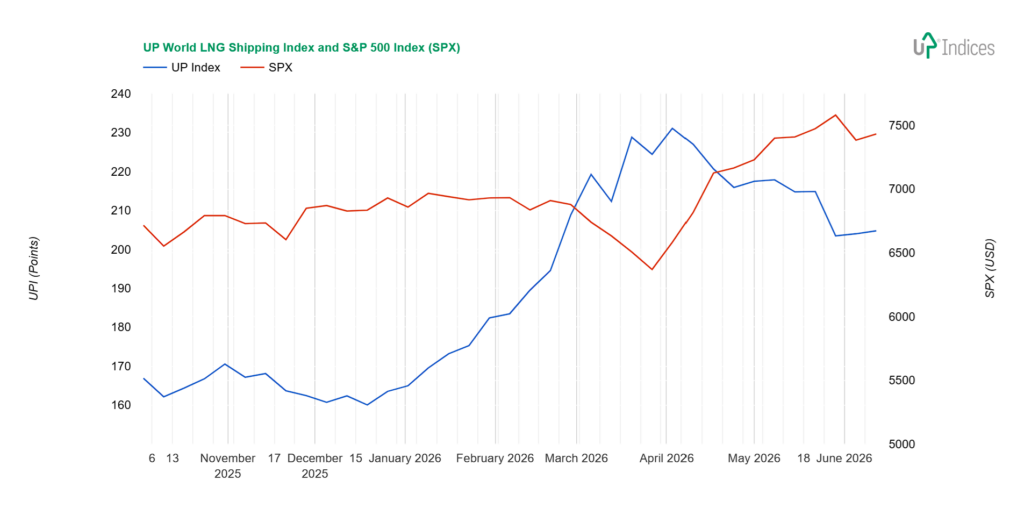
The UP World LNG Shipping Index gained 0.77 points (0.38%) last week, closing at 204.74 points, while the S&P 500 gained 0.65%. The UPI continues to move sideways above the 200-point mark, with the weighted index rising 1.05% and the median change at -0.05%. The ratio of advancing to declining stocks was 9:11, and trading volume remains low. Geopolitics remains the dominant driver: following the signing of a US–Iran memorandum, peace negotiations continue. The situation is easing, but not being resolved — and even a peace agreement is not viewed as a long-term stable solution. Qatar has been temporarily sidelined among the conflict’s losers due to industrial damage to its facilities, while US LNG exporters and European importers emerge as the clear winners. New global LNG producers should also benefit as energy-source diversification becomes more important than ever. ADNOC Logistics & Services led the gainers with a +7.71% gain, while ALNG suffered the largest decline at -5.36%.
UPI & SPX
The UP World LNG Shipping Index, which tracks 20 listed LNG shipping companies, gained 0.77 points (0.38%), closing at 204.74 points, while the S&P 500 index gained 0.65%. The chart below illustrates the performance of both indices with weekly data.
Broader View
The UPI continues to move sideways above the 200-point mark.
The ratio of rising to declining stocks was 9:11, and trading volume remains low. The weighted index (wUPI) rose by 1.05%, while the median change in the UPI was -0.05%.
Geopolitics remains the main driver of these movements. Following the signing of a memorandum between the U.S. and Iran, negotiations towards a peace agreement continue. The situation is easing, but not being resolved. We do not view even a peace agreement as a long-term, stable solution. This ongoing uncertainty may further weaken the Gulf states, particularly Qatar.
Gas continues to flow into Asia, with the spot price of natural gas reaching an 11-week high, according to a weekly Reuters summary. The drivers are the aforementioned geopolitics and weather conditions, with rising temperatures. Buyers in Bangladesh, India, and Pakistan have been actively tendering for cargoes with prices still below $20/mmBtu. Japanese and South Korean stock levels are below seasonal averages, and Northeast Asian buyers have been purchasing cargoes to bolster inventories, said Martin Senior, head of LNG pricing at Argus, as quoted by Reuters. European gas stocks are at unusually low levels of around 43%. The slow pace of stockpiling is primarily linked to market expectations that, should the Strait of Hormuz be reopened, much more LNG will become available and prices for the coming months will fall slightly, said Hans van Cleef, head of energy research at Eqolibrium.
Argus Media assessed the European price at $16.740/mmBtu, while Spark Commodities assessed the price at $16.688/mmBtu, again according to Reuters.
Spot rates, according to Spark Commodities, remain above $100,000 per day for the Atlantic and above $80,000 for the Pacific.
Constituents
Among individual companies, ADNOC Logistics & Services (ADX: ADNOCLS) posted the largest gain, rising 7.71%. This rise pushed it above the highest closing price range, but it remained at the magnetic resistance level of the highest prices. The breakout is therefore not yet complete.
The second-largest gain was posted by Excelerate Energy (NASDAQ: EE), which rose by 6.27%. In this case, this represents a rebound from the lower end of the sideways range.
Third on the list is FLEX LNG (NYSE: FLNG) with a 5.07% gain. In this case, a strong rebound from support has pushed the price into a range where further growth can be considered, at least up to the high of around $33. Investors likely appreciate the company’s transparency, the new contracts signed in the first quarter, and the stable dividend, though the company’s solid cash reserves partially support the latter.
In fourth place, with just under 4.8% growth, is Tsakos Energy Navigation (NYSE: TEN). For this stock, it represents a slight return above support, with the downside tested once again. There was no interest in a decline for the second week in a row, and growth has now followed.
New Fortress Energy (NASDAQ: NFE) posted the last gain of more than one per cent. It was +1.4%.
Golar LNG (NASDAQ: GLNG) has also been moving sideways below support for the third week. This week saw a 0.99% gain, which was not enough for a rebound.
Small movements this week masked significant efforts. For example, Korea Line Corporation (KRX: 005880) ended the week with a 0.2% loss. However, this movement hides the closing of a nearly seven per cent gap!
On the other hand, NYK Line (TSE: 9101) ended the week with a 0.4% gain but failed to sustain gains during the week.
In contrast, COSCO Shipping Energy Transportation (SS: 600026) can call its final half-per-cent loss a success, as Friday’s gain averted a more significant decline.
Dynagas LNG Partners (NYSE: DLNG) is moving sideways, with the final 0.5% gain masking a failed attempt at growth for the second week in a row. The price thus remains close to support.
ALNG (OSE: ALNG) posted the largest loss at -5.36%. In its case, this represented a break below support, but it remains held back by the shadow formed by the lower low on the weekly candlestick chart.
Capital Clean Energy Carriers (NASDAQ: CCEC) failed in its several-week-long attempt to break through resistance. The price could not hold near resistance and lost 3.8%.
“K” Line (TSE: 9107) fell by 2.92%, marking a failed attempt to continue the breakout. However, hope for another attempt remains.
NAKILAT (QSE: QGTS) continues its decline, having lost 1.9% last week and is now on track toward all-time lows. On the other hand, the decline was greater during the week but was successfully halted.
Crystal Ball
Qatar has been temporarily sidelined among the conflict’s losers due to industrial damage to its facilities, whilst US LNG exporters—and European importers—emerge as the clear winners. However, the vulnerable Panama Canal and ongoing US-Chinese tensions warrant attention. We expect most of the rising US gas production will flow towards Europe. New global LNG producers should also benefit from this conflict, as energy source diversification becomes more important than ever—provided importing economies remain healthy enough to absorb higher energy costs.
The second quarter is typically the weakest seasonally, but this year will be different—geopolitical circumstances have knocked nearly 20% of global LNG production offline. While Europe still enjoys a certain advantage over Asia, it now needs gas, and rising prices are hitting the poorest consumers, such as those in Bangladesh or Pakistan, the hardest.
The outlook remains volatile, but positive in the long term. Companies with spot tankers are benefiting from high rates and longer distances. The gradual phasing out of steamers and the addition of new liquefaction capacity will continue to drive the sector forward.
About UPI
Established in 2020, the UP World LNG Shipping Index is a rules-based family of stock indices designed to measure the performance of publicly traded companies worldwide engaged in the maritime transportation of liquefied natural gas (LNG). This unique index comprises 20 companies and partnerships worldwide, representing more than 65% of the global LNG carrier fleet in 2020. The UP Index provides premium services, offering freemium and trial access to charts. With the Freemium plan, users can access the basic UPI vs S&P 500 chart after completing email registration. The trial includes full access for fourteen days.
Final Note
This report primarily relies on technical analysis using weekly data. The summary section is AI-generated.