
Summary
The UP World LNG Shipping Index gained 10.41 points (4.99%) last week, closing at 219.21 points, while the S&P 500 fell 2.02%. The de facto closure of the Strait of Hormuz and the interruption of Qatar’s LNG production triggered a sharp spike in spot rates and roughly quadrupled trading volumes, with LNG shipping companies largely benefiting from the turbulent conditions.
Among the 20 constituents, gainers outnumbered decliners 14:6. Awilco LNG led with a 61% surge on full spot market exposure. At the same time, COSCO Shipping Energy Transportation rose over 20% for the second consecutive week, and Flex LNG gained 10.65%. On the downside, Excelerate Energy fell 10% following results, and Nakilat declined 7.71%. The short-term outlook remains risk-elevated; long-term fundamentals stay positive.
UPI & SPX
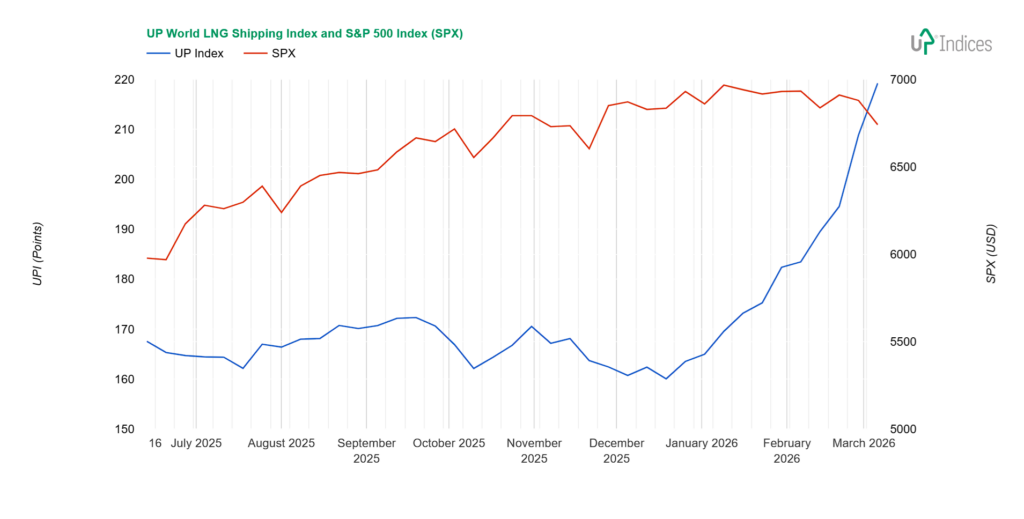
The UP World LNG Shipping Index, which tracks 20 listed LNG shipping companies, gained 10.41 points (4.99%), closing at 219.21 points, while the S&P 500 index lost 2.02%. The chart below illustrates the performance of both indices with weekly data.
Broader View
The UPI continues to grow strongly without correction and is now just below 220 points.
The first trading week after the Israeli-American attack on Iran brought turbulent developments, from which LNG shipping companies are largely profiting. The huge increase in spot rates (which was corrected this Monday) reflects the de facto closure of the Strait of Hormuz and the interruption of Qatar’s LNG production. However, not everyone managed to maintain high stock gains until the end of the week.
The turbulent developments were also reflected in a roughly fourfold increase in the volume of sha-res traded. The ratio of rising to falling UPI components was 14:6.
Constituents
Awilco LNG (OSE: ALNG) experienced significant growth in response to spot rates, rising by 61%. Both of its TFDE tankers operate in the spot market. Interestingly, on Friday, the company announced its intention to expand beyond being a pure LNG transporter to include LNG trading. This expansion involves a new minority investor and the issuance of new shares at NOK 3.25 per share for selected existing investors. Other current investors will also have the opportunity to participate in the share offering, although they will be able to purchase a smaller number of shares. The share price was presumably agreed upon before the recent developments, making what was previously perceived as positive news now seem slightly negative. All changes are still subject to approval at the extraordinary general meeting scheduled for March 30.
The private placement results in a significant dilution of about 37%, with shares issued at NOK 3.25—considerably below Friday’s market price. However, the company has also negotiated a reduction in its debt terms, lowering its break-even point from USD 56,800 to USD 39,000 per day. While this improves the balance sheet, the timing is unfortunate given the recent increase in spot rates, which means existing shareholders face dilution just as the company’s earnings potential has significantly improved. On a positive note, management is actively seeking growth opportunities.
The second-fastest-growing company was COSCO Shipping Energy Transportation (SS: 600026), which increased by more than 20% for the second straight week. Last week, it was exactly 22.64% and traded at triple the volume. The price is reaching levels seen in 2007-2008.
The third and final company to grow by double digits is Flex LNG (NYSE: FLNG), which is benefiting from its modern fleet and increasing spot rates. Weekly growth was 10.65%, pushing the price back above $30 and also at roughly triple the usual volume.
The growth of two companies begins with a seven: Dynagas LNG Partners (NYSE: DLNG) increased by 7.95%, and MISC (KLSE: 3816) rose by 7.81%. MISC maintains its upward trend, while DLNG aims to break through resistance. The price closed above the candlestick bodies, but growth above the resistance wicks was rejected. The price is therefore technically above resistance, but still within its “magnetic” range. Conversely, the attempt to retreat was also rejected. The volume was roughly double.
The price of Golar LNG (NYQ: GLNG) also broke above resistance, rising by 5.89%. Additionally, the traded volume was nearly three times higher.
Korea Line Corporation (KRX: 005880) did not sustain its significant midweek growth of 30%. The final increase of 4.84% remains a solid outcome. The high volatility is also evident in an eightfold rise in trading volume.
BP (NYSE: BP) also hit resistance after a 4% rise. The trading volume nearly doubled.
The Japanese trio of NYK Line (TSE: 9101), Mitsui O.S.K. Lines (TSE: 9104), and “K” Line (TSE: 9107) gained around 3%. Japanese shipping companies have numerous contracts with QatarEnergy, so after liquefaction capacities close, they will trade on the spot market. It will be interesting to observe their movements to see whether they head toward Australia or the US.
The biggest decline was not among companies from the Persian Gulf, but among Excelerate Energy (NYSE: EE), which dropped 10% after the results and reached the support area. Trading volume was double.
Nakilat (QSE: QGTS) dropped 7.71%. Its ships are likely to enter the spot market due to the inability to refuel in Qatar. ADNOC Logistics & Services (ADX: ADNOCLS) declined by 5.11%, falling below long-term support. Uncertainty also contributed to its decline.
The volatile period following the attack on Iran continues.
Crystal Ball
In the short term, geopolitical events raise the risk. The long-term outlook remains positive. The scrapping of steam vessels and the addition of new liquefaction capacity are pushing the sector higher.
About UPI
Established in 2020, the UP World LNG Shipping Index is a rules-based stock index family that measures the performance of publicly traded companies worldwide involved in the maritime transportation of liquefied natural gas (LNG). This unique index comprises 20 companies and partnerships worldwide, representing more than 65% of the global LNG carrier fleet in 2020. The UP Index provides premium services, offering freemium and trial access to charts. With Freemium, users can access the basic UPI vs S&P 500 chart after completing an email registration. The trial includes full access for fourteen days.
Final Note
This report primarily relies on technical analysis using weekly data. The summary section is AI-generated.