
Summary
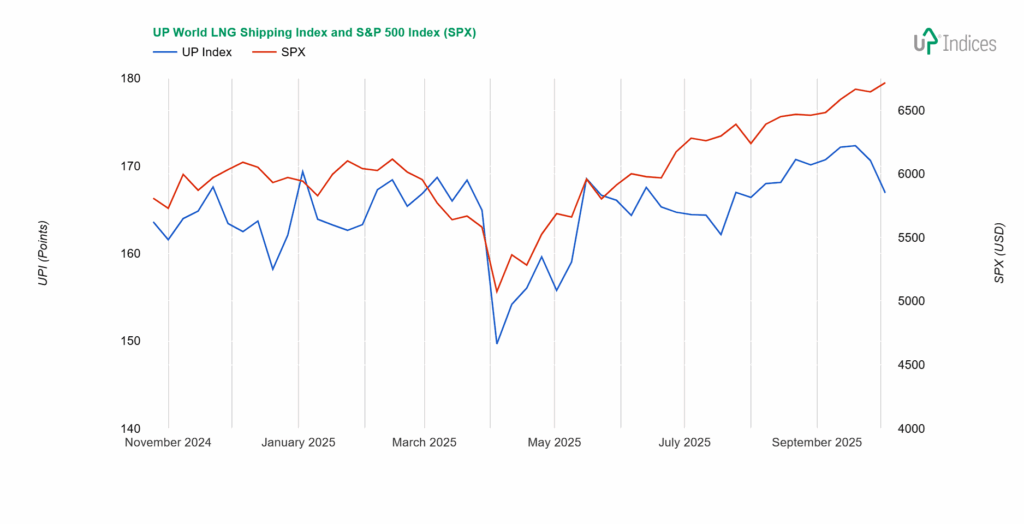
The UP World LNG Shipping Index (UPI) fell by 2.18% to 166.89 points, dropping below the 170-point threshold for the first time in months. The decline was mainly driven by a sharp pullback in Japanese carriers, with Mitsui O.S.K. Lines, “K” Line, and NYK Line all decreasing between 5% and 7%. Oil majors BP and Chevron also weakened by around 4%, which weighed on sentiment.
Despite the correction, several stocks showed resilience. New Fortress Energy recovered 16.6%, regaining early-September levels, while ADNOC L&S hit a new all-time high with a 4.15% increase. Cool Company continued to edge closer to its buyout price, while Excelerate Energy attempted to rekindle its upward trend.
Overall, the UPI’s decline signals the end of late-summer momentum and a return to its broader trading range. Nonetheless, underlying support remains robust, supported by long-term fundamentals for LNG shipping — demand growth, fleet renewal, and new terminal capacity — which keep the outlook positive.
UPI & SPX
The UP World LNG Shipping Index, which tracks listed LNG shipping companies, lost 3.73 points (2.18%), closing at 166.89 points, while the S&P 500 index gained 1.09%. The chart below illustrates the performance of both indices with weekly data.
Broader View
The UPI dropped below 170 points, signalling the end of growth. Similar to some constituents, the UPI returned to a sideways trading range. The sharp decline of Japanese companies, which lost around six per cent, had a significant impact.
The weakening of other companies does not seem severe and might be due to a correction of previous growth, a rebound to support levels, or a sideways trend. Trading volume was significantly below average, partly because of the Chinese holidays.
Constituents
The correction of previous growth within the uptrend is also evident in the case of the most weakened company, Awilco LNG (OSE: ALNG). It lost 9.6%, but still maintains a growing trend.
Next are three Japanese companies. The most notable decline was observed in Mitsui O.S.K. Lines (TSE: 9104), although it did not experience the largest loss among the companies. However, after a 6.4% drop, it broke through its support level and reached the 4,330 yen mark. If the decline continues, the 4,196-4,330 yen gap will close, a level below which the price has not been seen since its inception in December 2023. K Line (TSE: 9107) fell 7.7%, but this merely ended its growth spurt, and the price has now returned to a sideways trend. NYK Line (TSE: 9101) fared similarly, losing 5.3%. Its attempt at growth appeared the most serious, but it was halted and reversed within three weeks.
Next in line in terms of losses were BP (NYSE: BP) and Chevron (NYSE: CVX), which fell by 4.3% and 4.1%, respectively. Both are engaged in a tug-of-war over the continuation of their sluggish growth. The forces are evenly matched, resulting in sideways movement.
Capital Clean Energy Carriers (NYQ CCEC) is establishing a new price level between its current value and the one achieved last year, driven by summer growth. A loss of 3.7 per cent, combined with the pattern over the previous two weeks, suggests that the rally remains challenging, but nobody appears willing to decline.
Finally, Golar LNG (NYQ: GLNG) completes the list of notable declines. GLNG dropped 3.2% and remains at the support level after its previous attempt at growth in August was rejected.
Tsakos Energy Navigation (NYSE: TEN) is experiencing a slowdown in growth. The decline of 2.8% was more pronounced during the week, but was offset.
Dynagas LNG Partners (NYSE: DLNG) dropped 2.2%, but it only hit the support level.
Regarding growing companies, New Fortress Energy (NYQ: NFE) once again recorded the highest gains, and it was the only company to experience a double-digit increase. With a 16.6% rise, it regained its pre-slump levels in early September.
To paraphrase a saying, there is often nothing for an extended period until Adnoc L&S (ADX: ADNOCLS) rises with a 4.15% increase. However, this is a significant jump, as it is dominantly reaching new historical highs.
Cool Company (NYSE/OSE: CLCO) continued to strengthen marginally, nearing the announced buyback price, with a growth rate of 3.24%.
Excelerate Energy (NYQ: EE) showed growth of ‘only’ 2.29%, but this is moving beyond the previous range and marks an attempt at a new uptrend.
MISC (KLSE: 3816) recovered from its earlier decline below support by returning to it, rising by 1.4%.
Flex LNG (NYSE: FLNG) is trying to resume growth, which was halted by dividend payments, adding 1.3% last week.
Crystal Ball
The late-summer rise was rejected, and UPI returned to the previous range. This area provides strong support.
Our outlook remains steadfastly positive in the long term. The burgeoning demand for LNG, bolstered by situational or management-driven actions and the potential for new long-term contracts, paints a promising picture. Investors should watch policy developments, market competition, and upcoming corporate earnings for further direction.
About UPI
Established in 2020, the UP World LNG Shipping Index is a rules-based stock index family designed to measure the performance of publicly traded companies worldwide involved in the maritime transportation of liquefied natural gas (LNG). This unique index covers 21 companies and partnerships worldwide, representing over 65% of the world’s LNG carrier fleet in 2020. The UP Index offers premium services with freemium and trial access to charts. With Freemium, users can access the basic UPI vs. S&P 500 chart after completing an email registration. The trial includes full access for fourteen days.
Final Note
This report primarily relies on technical analysis using weekly data.