
Summary
Even the LNG shipping sector appeared calm last week, two perspectives emerge: one sees continued market calmness, while the other highlights ongoing adaptation to a shifting global landscape, particularly the rerouting of LNG flows as U.S. gas becomes less competitive in China due to tariffs. The UP World LNG Shipping Index (UPI) rose 1.21% during the shortened trading week, outperforming the broader market. Company performances were split, with gains from BP and Cool Company leading the way, while others like New Fortress Energy and Awilco LNG saw moderate declines. The overall trend hints at stability with pockets of growth and recalibration.
UPI & SPX
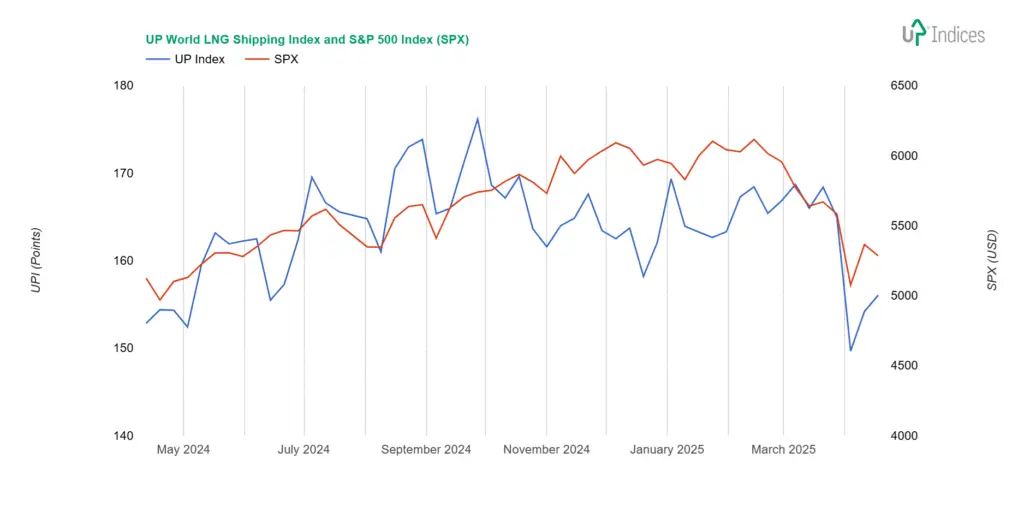
The UP World LNG Shipping Index, which tracks listed LNG shipping companies, gained 1.86 points (1.21%), closing at 156.03 points, while the S&P 500 index declined by 1.50%. The chart below illustrates the performance of both indices with weekly data.
Broader view
From one point of view, calmness in the markets continued last week; from another, the shift to a new normal continued. The shift mainly marks a change in the direction of global LNG flows, with tariffs making US gas unsellable in China.
According to the Reuters Global LNG report, spot freight prices fell for the fourth week to $21,750 and $23,250, respectively.
Constituents
UPI rose in the shortened trading week, and traded volume was average (so above-average if the week were complete).
The companies’ share price changes were mainly in two ranges: around zero and then between three and four per cent. The rising companies indicate the possibility of continued growth, whereas the falling companies were more of a price adjustment rather than a trend movement.
BP (NYQ: BP) and Cool Company (NYQ: CLCO) showed the biggest gains, adding 6.5 per cent and 6.4 per cent, respectively.
Groups moving between three and four per cent included Shell (NYQ: SHEL), which rose 4.8%, followed by Korea Line Corporation (KRX: 005880) and Flex LNG (NYQ/OSE: FLNG), which added 3.7% and 3.6%, respectively. With the opposite sign, a decline, were New Fortress Energy (NYQ: NFE) and Awilco LNG (OSE: ALNG), which lost 3.6% and 3.2%, respectively.
Misc (KLSE: 3816) and Golar LNG (NYQ: GLNG) improved their share price by 2.4% and 2.3%, respectively.
We’ve already mentioned the two major losers—NFE and ALNG—while the rest of the UPI constituents moved around zero gains or losses.
Crystal Ball
Despite the growing global uncertainty caused by the US administration, our outlook remains cautiously optimistic. However, we expect increased volatility in the coming weeks. LNG spot rates stayed low, but the impact remains marginal for most UPI constituents. The market is watching for potential breakouts at key resistance levels, which could determine the next price direction.
Our outlook remains steadfastly positive in the long term. The burgeoning demand for LNG, bolstered by situational or management-driven actions and the potential for new long-term contracts, paints a promising picture. Investors should watch policy developments, market competition, and upcoming corporate earnings for further direction.
About UPI
Established in 2020, the UP World LNG Shipping Index is a rules-based stock index family designed to measure the performance of worldwide publicly traded companies involved in the maritime transport of liquefied natural gas (LNG). This unique index covers 19 companies and partnerships worldwide, representing over 65% of the world’s LNG carrier fleet in 2020. The UP Index offers premium services with freemium and trial access to charts. With Freemium, users can access the basic UPI vs S&P 500 chart after email registration. The trial includes full access for fourteen days.
Source: UP-Indices.com via LNGshippingStocks.com